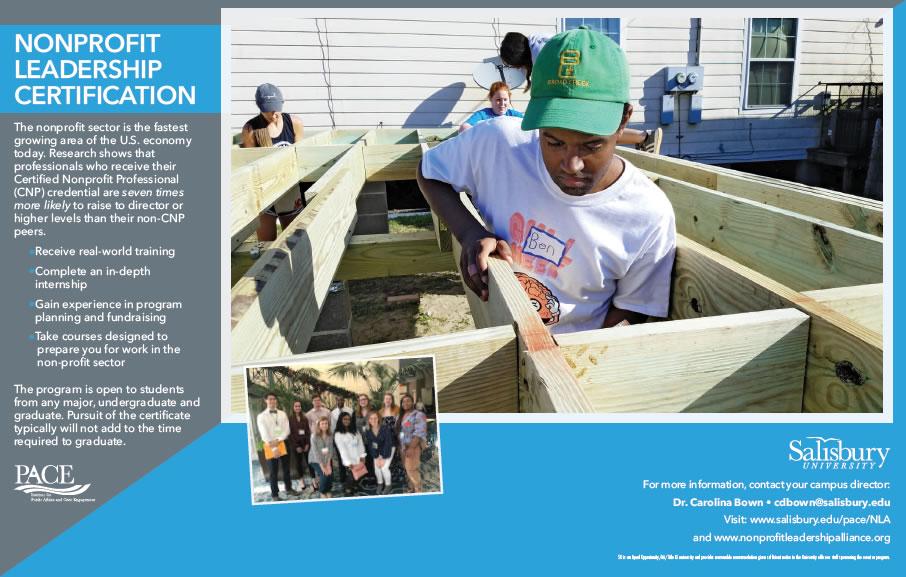
蜜桃av in partnership with the Nonprofit Leadership Alliance (NLA) offer the Certified Nonprofit Professional (CNP) credential to SU students. The program is open to students from any major, even graduate students, and pursuit of the certificate typically should not prolong time required to graduate.
Complete one of the following courses: PACE 250 (Nonprofit Fundraising and Volunteer Management, 4 credits) orIDIS 350 (Nonprofit Leadership, 3 credits) orCOMM 409 (Nonprofit Communication, 4 credits). By taking any of these courses, you will acquire knowledge and skills needed to professionally advance in the nonprofit sector. The above courses are also part of the requirements for the Nonprofit Leadership Minor. While all courses are open to all SU students, PACE 250 and IDIS 350 have no prerequisites at all.
Demonstrate your knowledge and stand out as a national certified nonprofit professional!
100 short-answer questions
76% is passing
To prepare for the CNP Exam you may take one of the eligible courses (PACE 250, IDIS 350, or COMM 409) offered in the Fulton School at 蜜桃av and/or study the CNP Study Guide on your own. You are encouraged to take other courses applicable to the nonprofit sector (e.g., marketing, communication, professional writing) and to participate in virtual or in person workshops on nonprofit issues.
How to Prepare for the CNP Exam
Review the CNP Study Guide Once you are enrolled in CNP Central, you will have access to the CNP Study Guide. This e-guide is designed to take 2-3 hours per week for 12 weeks. However, it is completely self-paced, so feel free to review the materials on a schedule that works for you. The CNP Study Guide is organized into six modules with four lessons each.
Take Nonprofit Coursework Have you taken any nonprofit focused college courses? If you haven’t, plan to take one. (Reminder: you have 3 years from your enrollment date to complete the requirements and earn your CNP). How do you know if your campus has a nonprofit course available next semester? You can go to the SU online course catalog and search “nonprofit.” If you find a course, you can build it into your schedule. You may also talk with your advisor in your major about whether a nonprofit course could count as an elective.
And don’t forget, many topics are relevant to nonprofit management. If you have taken any of the following courses, think about how the content applies to nonprofit organizations:
Leadership
Management
Human Resources
Budgeting
Financial Management
Accounting
Ethics
Marketing or Communications
Cultural Competency and Diversity
HELPFUL HINT: When taking a course, be sure to ask yourself, how does this content relate to nonprofit organizations? If you have an opportunity to select a leader or an organization for a project, go with a nonprofit focus. (These assignments can help you learn more about organizations where you might want to work.)
Participate in Webinars and Workshops We encourage you to participate in as many nonprofit-focused training and workshops as you can fit into your schedule. The Nonprofit Leadership Alliance offers free and discounted webinars and e-courses. The CNP Central Announcements will keep you informed. Eligibility: You may take the CNP Exam at any point after being enrolled in CNP Central. Join a study group to prepare for the exam. You can also access the CNP Study Groups through CNP Central.
Volunteer Service: Volunteerism is a key component for most nonprofits. More than 70 million adults (30% of the population) volunteer each year for nonprofit organizations—resulting in nearly 6.9 billion hours of volunteerism. This represents an estimated $167 billion in economic value.
The Volunteer Service requirement encourages CNP participants to understand the value of volunteerism. You'll gain first-hand perspective on how organizations work with volunteers to further their mission. This experience will also provide you with the opportunity to learn about an organization relevant to your interests and to make valuable connections in the nonprofit sector.
Eligibility: Complete at least 20 hours of volunteerism at a nonprofit organization and report at any time.
Leadership Development: Succeeding as a leader is not always straightforward. Effective leadership requires “soft” skills (also known as essential leadership skills). This is less about your straight knowledge and more about understanding complicated organizational and interpersonal dynamics. The best way to ensure you are setting yourself up for success is to adopt two mindsets. The first is continuous learning. The most successful leaders have a voracious appetite for learning new skills and developing their leadership capacity. The second is building professional networks. We know that a well-networked leader is a more successful leader. It is critical that you are building your ability to build those networks. Networks that will serve you today and for years to come.
Requirement: Conference, networking, career services
Eligibility: You may complete the leadership experience requirement at any time.
How: Participate in at least one of these three options for conferences:
The virtual conference Elevate, hosted by the Nonprofit Leadership Alliance in February every year.
The in-person Lower Shore Nonprofit Summit, hosted every spring on our SU campus.
A regional or national nonprofit conference like the Association of Fundraising Professionals (AFP).
Contact Dr. Carolina Bown at cdbown@salisbury.edu to discuss the best option for you!
To start:
Register directly in the Campus Partner Track at .
OR
Enroll in PACE 250 or COMM 409 or IDIS 350. The instructors in those courses will give you access to register in CNP Central. If you declare the Nonprofit Leadership Minor, two of these courses will count for the minor.
Contact Dr. Bown at cdbown@salisbury.edu with any questions and to design your own customized nonprofit certification plan!
The nonprofit sector is the fastest growing area of the U.S. economy today and includes organizations from neighborhood associations to large foundations focusing on such areas as the environment, the arts, international development, and social services. Research shows that professionals who receive their Certified Nonprofit Professional (CNP) credential are seven times more likely to raise to director or higher levels than their non-CNP peers.
Prepare yourself for the future and start pursuing your CNP credential today!
You are on the path to be a certified nonprofit professional!